When the Lamps Go On at Three: Why November's Early Dusk Makes the Truest Family Portraits
There is a moment in November, usually a bit after three, when the sky gives up and the lamps come on. The back garden goes blue. Someone switches on the kitchen light. The kettle starts again. I used to think of that moment as the enemy of a family shoot. Now I think it is the most honest light we get all year.
November has a reputation problem. We treat the early dark as a failure of the day, something to be worked around or apologised for. But the families I photograph in late autumn are not performing for a bright summer field. They are at home. They are half in their coats. There is mud on the floor and a pan on the hob. The light is low and close and yellow at the edges. And that, very often, is where the real portrait is.
The afternoon doesn't end, it turns inward
A July shoot gives you space. A November shoot gives you proximity. The sofa becomes the studio. The window becomes the light source. Everyone has to sit a little nearer to each other, and that nearness does something to a photograph that no amount of golden-hour haze can do.
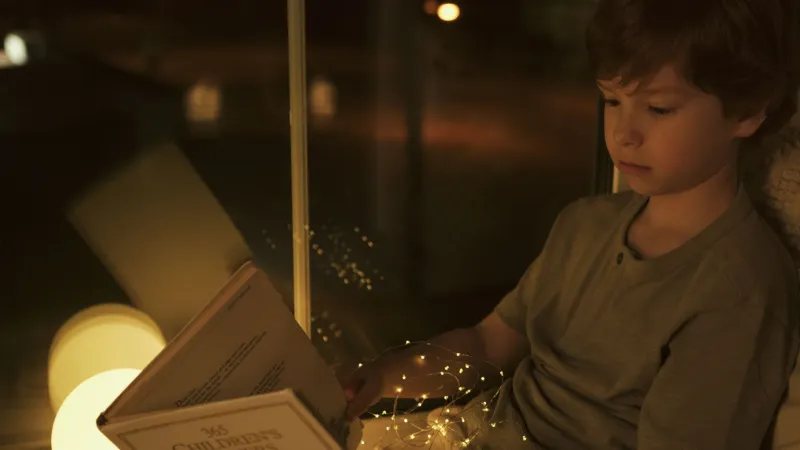
I notice it most with children. In summer they run. In November they lean. They bring a blanket over, or they climb onto a lap without being asked, or they stand at the window watching the rain because there is nothing else to watch. Those are not poses. They are the small movements of a family settling in for the evening, and they photograph beautifully.
The trick is to stop fighting the clock. If you arrive at a house at 2.30pm in November and try to recreate a bright summer shoot, you will lose. If you accept that the good light is already indoors, you win. The afternoon has not ended. It has simply moved inside and asked everyone to gather round.
Muddy boots are part of the story
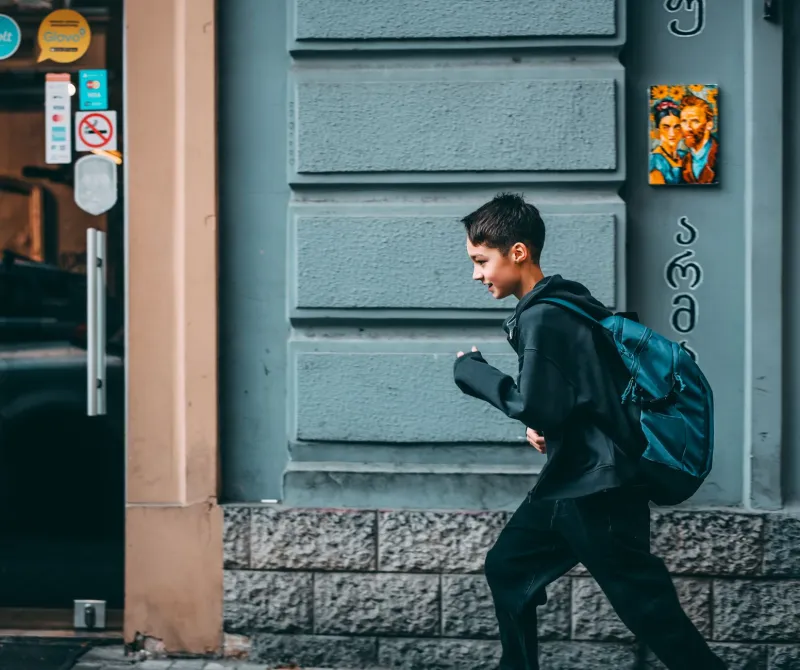
I have photographed enough families to know that the coats never quite get taken off. Someone is always halfway out of a jacket. Someone is still in wellies. There is a school bag in the hall and a dog who has just come in from the garden and a radiator that is doing its best.
For a long time I thought I had to tidy that away. Now I photograph it. The mud by the back door says this family goes outside. The coat that stays on says someone was cold and came in and got distracted. The pile of shoes says real life happens here. These are not flaws in the frame. They are the evidence.
November portraits are full of that evidence. Summer can be too clean. Winter, with its early dusk and its indoor rituals, has texture. It has the wool of a jumper, the shine of wet pavement through the window, the orange glow of a lamp on a white wall. It has the truth of a family who are not quite ready for the camera because they were not expecting to be.
Fairy lights aren't a prop, they're a clue
I love a string of fairy lights in a November portrait. Not because they are pretty, although they are. Because they tell you something about how a family makes it through the dark months. They are a small act of defiance. A bit of warmth on a windowsill. A signal that someone in this house decided to make the early evening feel like an occasion.
When I photograph them, I don't switch them on to create a mood. I switch them on because they were already there, or because the family put them up last week and forgot to take them down. They sit in the background, out of focus, doing what they do. That is the point. A portrait that includes the small comforts of a home is a portrait that remembers the home, not just the faces.
The same goes for the lamp in the corner and the candle on the mantelpiece and the television glowing in the other room. Low light does not mean no light. It means noticing the light that people actually live by.
What to do if you're the one holding the camera
If you are taking your own family portraits this November, the first thing to do is turn off the ceiling light. It is doing you no favours. Find the biggest window in the house, put everyone near it, and let the grey-blue afternoon do the rest.
Then bring in the lamps. A warm bulb in the corner, a fairy light on the wall, a candle on the table — these are your friends. They add depth and colour and a sense of a room that is being used. You do not need a studio. You need a sofa and a bit of patience.
You will probably need to raise your ISO. That is fine. A little grain in a November portrait feels like memory. It feels like film. It feels like the photograph was taken in a real house on a real afternoon when the light was going and nobody minded.
And keep everyone close. The further apart people sit, the more the low light has to travel. A huddle on the sofa, a child on a knee, two heads leaning together at the kitchen table — that is the composition November gives you for free.
The portraits summer can't give you
I am not against summer. I photograph families in June and July and the light is generous and the gardens are open and everyone is glad to be outside. But the portraits I remember most are often the ones taken when the day was already ending. The ones where someone is still in their coat. The ones where the lamp is on and the rain is on the window and the dog has muddy paws.
That is the quiet gift of the short afternoon. It does not ask a family to be anything other than what they are. It does not offer a horizon or a golden field. It offers a window, a warm bulb, a bit of mess, and the chance to sit close together because the dark is coming in.
If you have been waiting for better light, this is your reminder that the better light is already here. It arrives at about three o'clock, and it stays until bedtime. All you have to do is let it in.