Shoes Off, Lights Low: In Defence of the Wedding Day's Quietest Hour
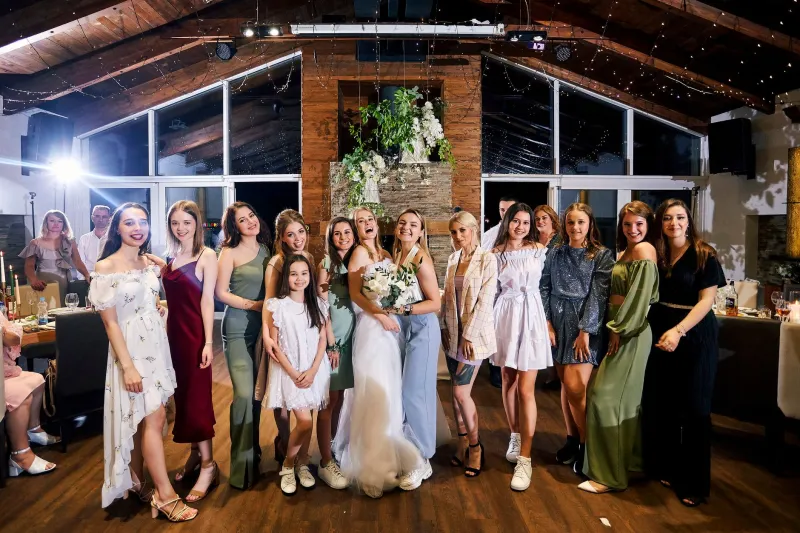
Four o'clock is when a wedding exhales. The speeches are done or nearly done, the roast has settled, and the room has quietly divided itself into two camps: people who need to sit down, and people wondering when the dancing starts. Nobody has scheduled anything for this bit. That is exactly why I love it.
I've photographed enough UK weddings now to spot the pattern from a distance. The morning runs on adrenaline. The ceremony runs on nerves and whatever the weather is doing. Confetti is thirty seconds of glorious chaos. And then the afternoon rolls on and everyone — guests, couple, even the band sound-checking in the corner — hits a wall somewhere between the coffee and the evening do. In July it tends to arrive around half three. In November, with the light gone by quarter past four, it lands earlier and slightly harder.
What actually happens at four o'clock
Shoes come off. Not dramatically — just a slow surrender by the edge of the dance floor, a row of heels and one pair of Clark's loafers lined up like they're waiting for a bus. Someone's nan claims the good armchair and is not moving for anyone. A toddler falls asleep across two folded coats on a bench, one arm dangling towards the carpet. The bride is sitting on a step with her dress bunched up around her knees, eating something she definitely shouldn't be eating in that dress. The groom is outside with his dad, neither of them saying a word, both of them looking at the same patch of sky.
Nothing here is being performed. That's the thing. For six hours your guests have been on their best behaviour, and for one hour they forget to be, and the room becomes a room again instead of a set.
Why the in-between frames outlive the confetti
I'll say the unpopular thing: a confetti shot is a lovely thing, but it is also a shot that looks broadly like every other confetti shot taken in Britain this year. Peak moments are repeatable. The lull is not.
It's also more honest. Anyone can look joyful in the two minutes after a first kiss. What tells you something about a couple is how they sit together when there's nothing to do — whether they talk, whether they don't need to, who gets up to fetch the other a drink without being asked, who takes the sleeping child off a cousin so she can eat her pudding in peace. Those are the frames that answer the question a wedding album is really asking: what is this pair of people like?
I have never once had a couple email me two years later asking for more pictures of the cake cut. I have had several ask for the one of them on the steps with their shoes off.
Protecting the hour — notes for couples
You don't need to choreograph this. You mostly need to stop your plans from eating it.
- Leave a genuine gap. If the day is back-to-back, the lull has nowhere to land. Fifteen minutes of nothing between the meal and the evening is worth more than an extra lawn game.
- Give your photographer permission to wander. A short note in the brief — 'disappear for a bit after the speeches, shoot whatever's happening' — is the single most useful line you can write.
- Tell your venue you'd like somewhere to sit. A snug, a side room, a quiet corridor. British venues are full of them; nobody ever asks.
- Feed people at half three. Hungry guests don't lull, they fray. A tray of sandwiches does more for your photographs than a saxophonist.
- Let the children go feral. The best images of the day are usually the ones where somebody's four-year-old has given up entirely and is asleep under a table with their shoes on the wrong feet.
- Don't schedule photographs into it. If I'm chasing a group shot list at four o'clock, I've missed the hour entirely.
For whoever is holding the camera
Read the room rather than the shot list. Look past the wedding party — the second row, the aunty by the window, the two groomsmen who've found the only quiet corridor in the building. Watch the light in the gaps: a doorway, a half-open curtain, the low gold coming in sideways across a tablecloth at ten to five in September. Put the flash down. Sit at the same height as the people you're photographing, which at four o'clock often means sitting on the floor.
And resist the urge to improve anything. If the room looks a bit of a state, that's the record. That's the actual afternoon.
The case for fewer peak moments
A wedding album built entirely from peaks — the kiss, the confetti, the first dance, the sparkler exit — is a highlight reel. It's exciting and it's a little bit airless. Add the lull and it becomes a day. Punctuation matters, but you can't read a sentence made only of exclamation marks.
Four o'clock will not photograph itself, and it won't be on anyone's timeline, and the DJ will probably be playing something slightly wrong through the speakers while it happens. Give it space anyway. It is the hour your wedding stops being an event and starts looking like the rest of your life together — a bit tired, a bit untidy, and entirely worth keeping.